Mobile Computers - Data Terminals
Mobile Computers by Symbol, HHP, Intermec, Wasp & More.
System ID warehouse offers mobile computers tailored to fit any application. Whether the application is inside an office or in the most extreme and rugged conditions System ID has the mobile computer for your company needs. How does System ID do it? We have strong and the highest levels of partnerships with many of the leading manufacturers including Datalogic, Honeywell(formerly Hand Held Products), Intermec, Motorola(formerly Symbol), Wasp, and many others.
| Call 1.888.648.4452 for the best prices from the following manufacturers: | |||||
|
|
|
|
|
|
|
Compact Mobile Computers 
Very thin form-factor, usually no touch screen.
![]() |
![]() |
![]() |
| Wasp WDT2220 Mobile Computer | Opticon PHL 1300 Mobile Computer | Unitech HT580 Mobile Computer |
| Includes free application generation software. | It may look like a cell phone, but this is made for data capture. | Made for straight forward and easy data collection. |
$899.00 |
$569.00 |
$309.00 |
Key-Based Mobile Computers 
The most rugged mobile computers, with touch screen and many keys for data entry.
![]() |
![]() |
![]() |
| Motorola (Symbol) MC9090 Mobile Computer | Datalogic Kyman Mobile Computer | Honeywell Dolphin Mobile Computer |
| Rugged and durable the 9090 is System ID's best selling key-based mobile computer. | New to the Americas in 08, this unit has alreay had success in Europe. | See the unique ability of Adaptus Imaging. |
$2289.00 |
$1917.36 |
$2159.00 |
Pen-Based Mobile Computers 
A ruggedized PDA and a built in scanner
![]() |
![]() |
![]() |
| Intermec CN3 Mobile Computer | Motorola (Symbol) MC70 Mobile Computer | Wasp WPA1200 Mobile Computer |
| So much power in the palm of your hand. | Everything your employees need to increase productivity in or out of the four walls. | Works great with Wasp MobileAsset and InventoryControl |
$1995.00 |
$1849.00 |
$1649.00 |
Tablet Mobile Computers 
Designed not to fit in your hand, but rather on your arm or mounted to a vehicle
![]() |
![]() |
![]() |
| Motorola (Symbol) VC5090 Mobile Computer | Intermec CV30 Mobile Computer | Bosanova 360XP Mobile Computer |
| Designed for almost anywhere inside the four walls. | Flexible for many applications because of its compact design. | Use pre-recorded macros for easy navigation |
$3729.00 |
$3895.00 |
$1890.00 |
Barcode Scanners 
Looking for a barcode scanner?
![]() |
![]() |
![]() |
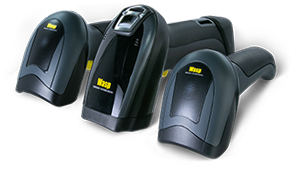
| Datalogic Heron-G D130 Barcode Scanner | Hand Held Products 3800G Barcode Scanner | Wasp WWS800 Barcode Scanner |
| Green dot technology for noisy environments. | How do you spell imaging technology? H-O-N-E-Y-W-E-L-L. | Go cordless ( bluetooth ) with exceptional range. |
$169.00 |
$239.00 |
$595.00 |
Mobile Computers 101 |
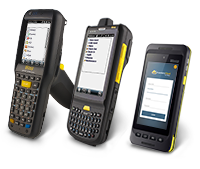
A mobile computer data terminal sometimes called a portable data terminal (these terms will be used interchangeably) is similar to a personal digital assistant. However, mobile computer data terminals are more rugged than PDA’s and mobile computer data terminals on our web-site have a scanner incorporated into the device. Even though mobile computer data terminals are classified into one group there are many different options and configurations to choose from. The information below will help narrow the selection process.
What Type is Right for my Application?
Compact Mobile Computers |
Compact Mobile Computers have a smaller form factor. Typically they have a less sophisticated operating system. Some of the most popular compact mobile computers are made by Code, Opticon, Unitech, and Wasp.
Key-Based Mobile Computers |
Key-Based Mobile Computers are extremely rugged devices. Key-based mobile computers have many key configuration options and many keys for easier user functionality. The leading sellers in key-based mobile computers are Datalogic, Honeywell, Intermec, and Motorola.
Pen-Based Mobile Computers |
Pen-based Mobile Computers resemble PDA’s but are much more rugged. Pen-based mobile computers typically only come in two key configuration options: QWERTY or 4-PIM key (for navigation). The leading pen-based mobile computers are manufactured by Datalogic, Honeywell, Intermec, Motorola, and Wasp.
Tablet Mobile Computers |
Tablet computers are extremely rugged computers designed to mount to warehouse vehicles like forklifts or designed to be held like a tablet. Bosanova, Intermec, and Motorola are leaders in tablet computers.
Batch vs. Wireless
Batch data collection is when data is entered into the mobile computer data terminal and is stored in the portable data terminal’s memory. When this type of data collection is utilized, the user must take the portable data terminal back to a cradle or dock, which is connected to a PC where the information is then uploaded into the database. Wireless data collection is when data is collected utilizing a wireless network. Wireless data collection allows for real time information to be accessed by the mobile user and real time updates to bo sent to the host system.
The advantage of batch data collection compared to wireless data collection is a cost savings in hardware. Batch mobile computer data terminals are less expensive and do not require the need to installation of W-LAN infrastructure. W-LAN infrastructure includes but is not limited to access points and wireless switches/controllers. The advantages of wireless batch data collection are increased productivity, real time information, and better response times. System ID strongly recommends having a site survey conducted before purchasing or installing W-LAN infrastructure.
The Operating System
The operating system on a mobile computer is similar to the operating system on computers. Even though some portable data terminals use a DOS OS, most data terminals have a more common windows platform like Windows Mobile 5.0 and Windows CE (WinCE) 5.0. Windows CE (WinCE) is a RTOS that you can use to build robots, industrial controllers, Internet appliances, etc. WinCE comes with a Platform Builder tool that allows you to select the components you want for your platform. Developers can extend the platform you created, but the platform will not be a set standard. On the other hand, Windows Mobile (WM) is a standard platform for PDAs and cell phones. The Windows Mobile team selected the Windows CE components for the WM platform and created a kit for vendors. Devices based on this kit are known as Windows Mobile-based devices.
Scan Engines
There are four basic types of scan engines to consider when choosing a mobile computer: laser, linear imager, 2D imager, and long range. Laser scan engines use a laser beam as the light source and typically employ either a reciprocating mirror or a rotating prism to scan the laser beam back and forth across the barcode. Laser scan engines in the past have been viewed as faster than linear imaging and do better in very bright environments, for instance, when scanning outside.
Linear imaging, also called CCD (charged coupled device), uses an array of hundreds of tiny light sensors lined up in a row in the head of the reader. Instead of emiting a single line like a laser scanner, linear imagers emit a larger rectangle allowing the user to know what area is being scanned.
2D imagers work the same way that a linear imagers do except that it can read 2D barcodes. 2D barcodes work on two planes instead of one, because of this a 2D barcode can contain a lot more information. Some barcode symbologies can even have the whole “Delcaration of Independence” encoded in them. In a sense a 2D imager is taking a picture, because of this the barcode does not have to have a specific orienation.
Long range scanners allow the user to scan barcodes from a long distance. It use to be that if a user was using a long range scanner that they could only scan barcodes from a long distance, up to about 30’. With recent scan engine breakthroughs users are able to have much more flexibility in scanning barcodes more closely and far away. Typically long range scanners are used to scan location tags hanging from the ceiling.
IP Rating
Another feature that is often advertised for portable data terminals is IP rating. The first digit in IP rating indicates the level of protection that the enclosure provides against access to hazardous parts (e.g., electrical conductors, moving parts) and the ingress of solid foreign objects. Most of the time with mobile computer data terminals, a number five or six will be the first digit. The five means that it is dust protected. Dust protected means that ingress of dust is not entirely prevented, but it must not enter in sufficient quantity to interfere with the satisfactory operation of the equipment. A six means that it is dust tight, which means no ingress of dust.
The second digit is protection of the equipment inside the enclosure against harmful ingress of water. The most common numbers that are seen four, five, and six. The four means that the unit is protected against splashing water. When the second digit of the IP rating is five, that means it is protected against water jets. When water is projected by a nozzle against the enclosure from any direction it shall have no harmful effects on the portable data terminal. On a rare occasion the second digit will be a six. If the mobile computer data terminal does not show harmful effects after water is projected in powerful jets against the enclosure from any direction, the second digits rating will be a six.
*All information on this page is the copyright property of System ID Warehouse and cannot be reproduced without the expressed written consent of System ID Warehouse. Copyright ©2001.